

Money Transfer
A Canadian business can end up converting the same money more than once. You might receive USD from a customer, convert it to CAD automatically, then buy USD again a few weeks later to pay a supplier. Each conversion can add cost and makes cash flow harder to manage.

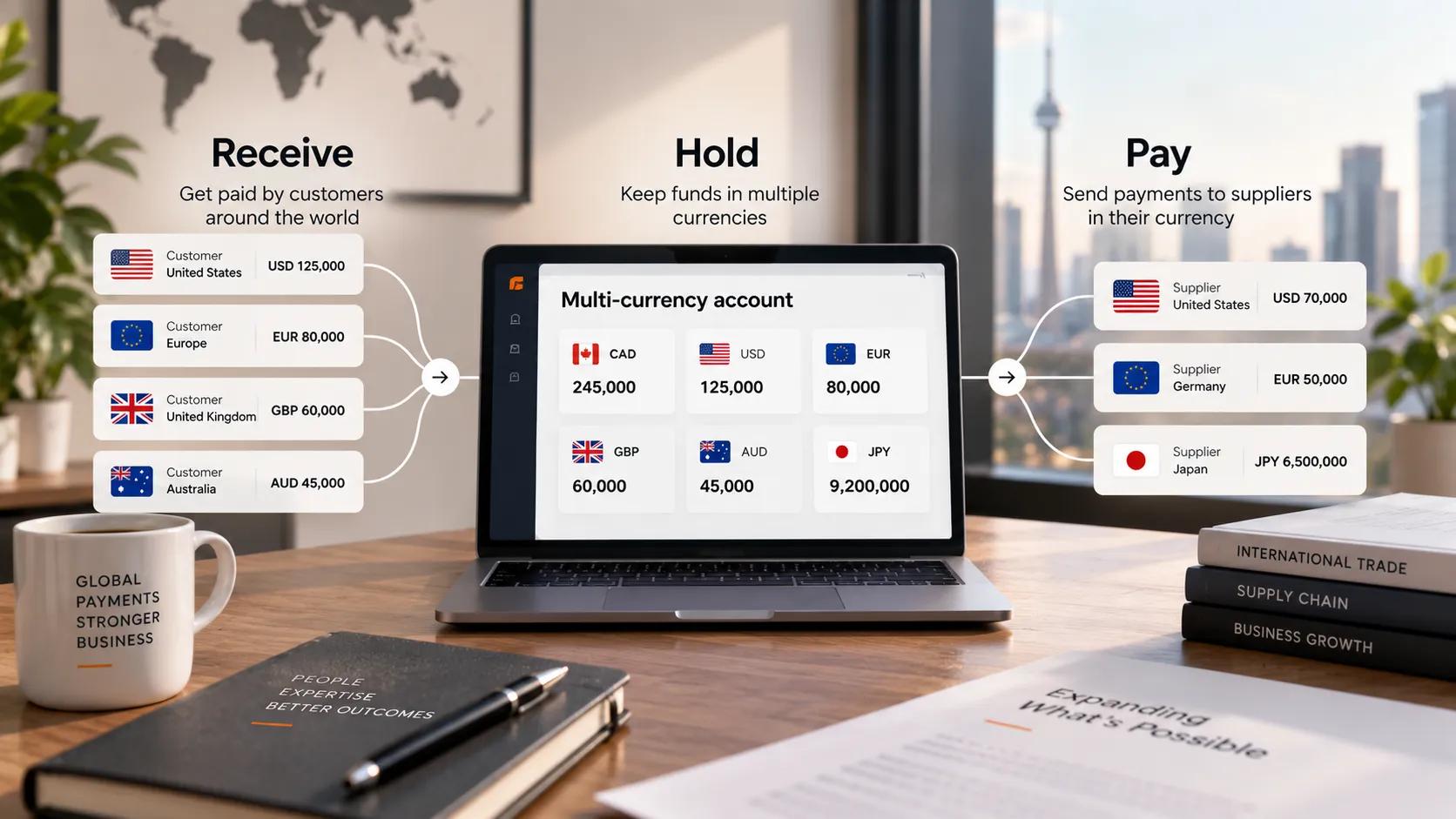
A multi-currency account gives a business another option: receive, hold, convert and pay in several currencies from one place. For companies with regular foreign-currency inflows or outflows, that can simplify international payments and give the finance team more control over when conversions happen.
What is a multi-currency account?
A multi-currency account is an account structure that lets you maintain balances in more than one currency without converting every incoming or outgoing payment back to Canadian dollars. Depending on the provider, you may also receive local account details for major markets, make payments from those balances and convert between currencies when needed.
Businesses searching for a multi-currency bank account are usually looking for the same practical outcome: one place to manage currencies such as CAD, USD, EUR and GBP. The exact legal structure and banking arrangements can vary by provider, so review how the account is held, how payments are routed and what safeguards apply before opening one.
How does a multi-currency business account work?
The basic workflow is straightforward. A business adds the currencies it uses, receives funds into the relevant balance, keeps those funds in that currency if useful, and then either converts them or sends them to another recipient. With MTFX, businesses can hold, send and receive in 50+ currencies, while local or virtual account details are available for key markets such as the US and Europe. MTFX also supports payments to more than 190 countries.
ILLUSTRATIVE EXAMPLE: A business receives US$50,000 from a customer and later needs to pay a US$30,000 supplier invoice. If the USD can be held and US$30,000 paid directly from that balance, the company may avoid converting that portion to CAD and then buying USD again. Actual savings depend on the rates, fees and payment routes involved.
Where can a multi-currency account save money?
The strongest savings case usually comes from reducing unnecessary conversions rather than trying to predict the perfect exchange rate. The account can be especially useful when the business earns and spends the same foreign currency.
Avoid double conversions: use foreign-currency receipts to fund expenses in the same currency where appropriate.
Choose when to convert: hold a balance instead of accepting an automatic conversion each time a payment arrives.
Receive locally in key markets: local receiving details can make it easier for overseas customers or platforms to pay in their own market.
Consolidate currency management: track multiple balances and payments from one platform instead of maintaining separate workflows for every currency.
Which businesses benefit most?
Common use cases
Business profile | Why currency balances matter | Practical benefit |
Exporter | Receives USD, EUR or GBP revenue | Hold receipts and convert when required instead of automatically |
Importer | Pays recurring foreign suppliers | Fund payments from matching currency balances when available |
E-commerce or SaaS | Collects from customers or platforms in several markets | Keep different revenue currencies visible in one place |
Global services firm | Invoices clients and pays contractors internationally | Match foreign receivables with foreign operating costs |
When might your business not need one?
A multi-currency account is not automatically useful for every company. If you make one or two small foreign payments each year, receive almost all revenue in CAD, and rarely hold foreign currency for more than a few days, a standard international payment service may be simpler. The extra balances only add value when they solve a recurring payment, collection or conversion problem.
There is also a cash-management trade-off. Holding foreign currency exposes the CAD value of that balance to exchange-rate movements. A business should therefore have a clear reason for holding each currency, rather than accumulating balances simply because the account makes it possible.
What should you compare before opening an account?
Supported currencies and receiving details. Confirm the currencies you can actually hold and whether local account details are available in the markets where customers pay you.
FX pricing and transaction fees. Compare the actual conversion rate, transfer charges and any costs associated with receiving or withdrawing funds.
Payment capabilities. Check whether you can pay suppliers, make batch payments, schedule transfers and use the currencies you hold without forced conversion.
Controls and visibility. Look for approval processes, payment tracking, statements and a clear view of each currency balance.
Support for FX risk management. If your exposures are material, rate alerts or forward-contract options may be more important than the account itself.
How MTFX supports multi-currency businesses
MTFX provides a multi-currency business account that can hold, send and receive in 50+ currencies. Businesses can access local or virtual receiving details in major currencies, manage balances from one platform, and send payments to more than 190 countries.
For companies that also collect internationally, MTFX global collections can help receive payments in foreign currencies before the business decides whether to hold, convert or use those funds for future payments. The practical benefit is control: fewer unnecessary conversions and a clearer view of foreign-currency cash flow.
Frequently asked questions
Is a multi-currency account the same as a multi-currency bank account?
The terms are often used interchangeably in search, but the underlying structure can differ. Some products are traditional bank accounts, while others use virtual or local account details through payment and FX providers. Check who holds the funds, how payments are routed and the applicable terms.
Can a multi-currency account reduce FX costs?
It can reduce avoidable conversion costs when a business receives and pays the same foreign currency or wants more control over conversion timing. It does not eliminate FX costs or guarantee that holding a currency will produce a better rate.
What currencies can MTFX businesses hold?
MTFX states that its multi-currency account supports 50+ currencies, including major currencies such as CAD, USD, EUR, GBP and JPY. Availability of specific receiving details or payment routes can vary by currency and market.
Does every international business need a multi-currency account?
No. It is most useful when foreign-currency activity is regular enough that holding balances, receiving locally or matching inflows with outflows solves a repeated cost or workflow problem.
Give every currency a job
A multi-currency account works best as a cash-flow tool, not as a collection of idle balances. Map the currencies your business receives, the currencies it pays, and when conversions are actually necessary. If those flows overlap regularly, a multi-currency account can reduce friction and give your finance team more control over international business payments.