

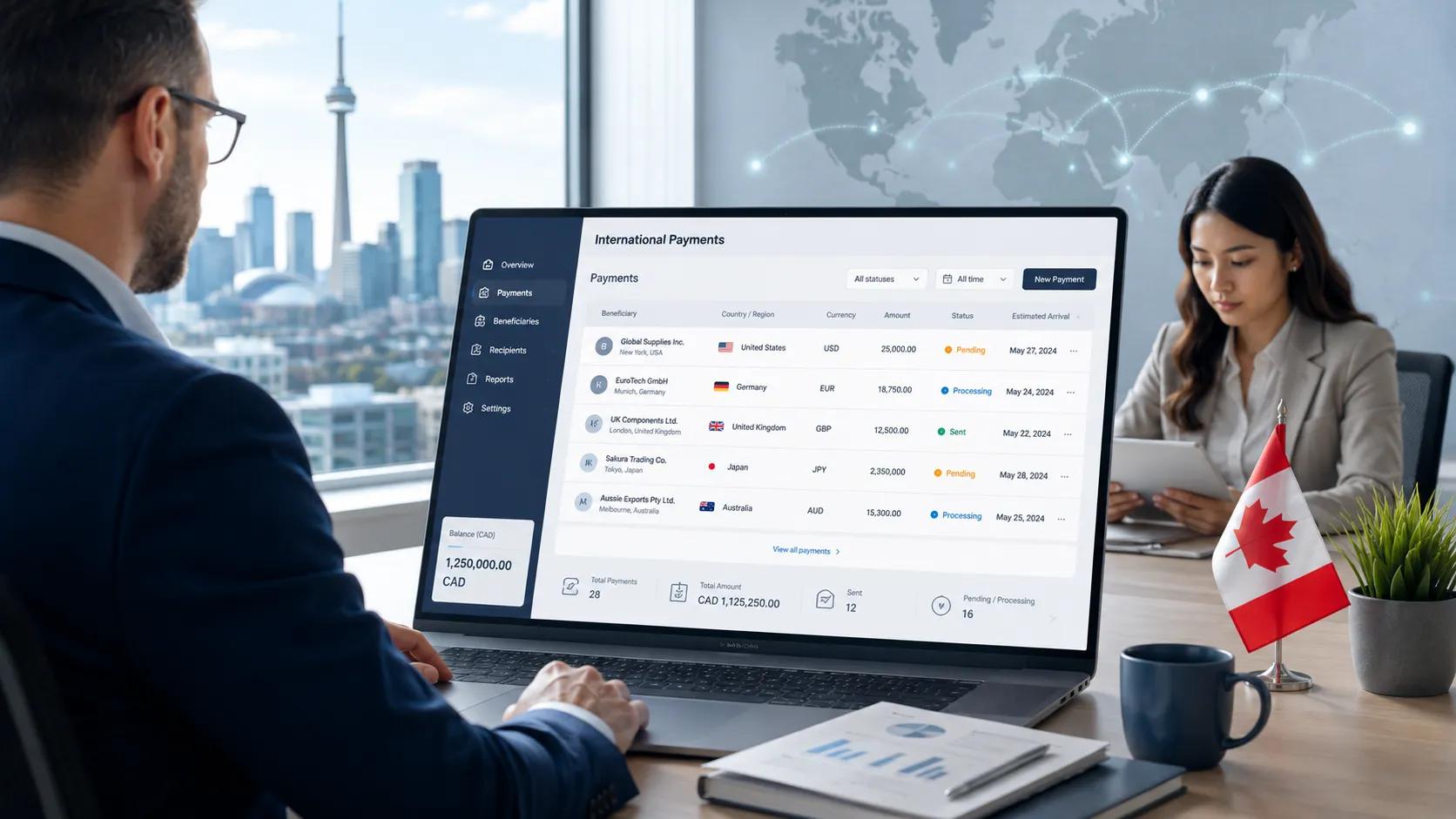
For Canadian businesses, sending money across borders is more than choosing a currency and clicking send. A supplier may need an exact amount in euros, a contractor may invoice in US dollars, or an overseas partner may expect payment on a fixed date. The goal is to make global payments overseas with control over the exchange rate, total CAD cost, beneficiary details and delivery timing.

Start with the foreign currency obligation
Before comparing providers or rates, define what the business owes. Confirm the beneficiary’s legal name, invoice or contract reference, destination country, required currency, exact amount and due date. If the recipient must receive a fixed amount after deductions, make that requirement clear before approval.
A fixed CAD budget answers how much foreign currency can be purchased; a fixed foreign currency invoice answers how much CAD is required. Work backwards from the amount due and leave time for approval, funding, compliance review and bank cut-offs.
Compare the exchange rate and the full CAD cost
The exchange rate is only one part of a cross-border payment. There may also be transfer, funding, intermediary or receiving-bank charges. Compare the total CAD debit with the amount expected to reach the beneficiary, not simply the headline fee.
Bank of Canada exchange rates are useful reference points, but the Bank describes them as indicative averages rather than transaction rates. For a CAD to foreign currency money transfer, obtain a live quote and confirm the pair direction. If the quote is foreign currency per CAD, divide the foreign-currency obligation by the rate; if it is CAD per foreign-currency unit, multiply.
ILLUSTRATIVE FIXED INVOICE CALCULATION - If a supplier invoice is €20,000 and the live transaction quote is 1 EUR = C$1.61, the currency amount is €20,000 × 1.61 = C$32,200 before any separate charges. Use a current transaction quote; this example is not a live rate.
Match the payment structure to the business need
Payment situation | What matters most | Practical control |
|---|---|---|
One-off supplier invoice | Exact foreign-currency amount, due date and beneficiary details | Verify the invoice and payee, compare the all-in CAD cost and retain payment confirmation |
Recurring contractor or vendor | Payment calendar, consistent controls and forecast currency need | Use a repeatable approval process, keep beneficiary records current and review the rate for each cycle |
Multi-payee or high-volume run | Accuracy across many beneficiaries, currencies and references | Use batch workflows where suitable, validate payment data before upload and require an approval check before release |
A six-step workflow for cross-border business payments
Use the same control sequence for one overseas supplier, a recurring contractor or a batch of international invoices.
Validate the obligation. Match the invoice or payment request to the purchase order, contract or approved expense. Confirm the currency, amount, due date and payment reference.
Verify the beneficiary. Confirm the recipient’s legal name, address, bank, account or IBAN, and required routing or SWIFT/BIC information through a trusted source. Independently verify unexpected bank-detail changes.
Build an all-in quote. Review the transaction exchange rate, total CAD debit, transfer or funding charges, expected foreign currency amount and estimated delivery. Compare quotes taken at roughly the same time.
Approve the transfer. Apply your normal segregation-of-duties controls. For material payments, have a second authorized person review the beneficiary, CAD cost, foreign currency amount and deadline before release.
Fund and send early enough. Account for funding time, bank cut-offs, weekends, holidays and possible document requests. A payment initiated at the invoice deadline leaves little room to correct an error.
Confirm receipt and reconcile. Save the quote and payment confirmation, send remittance advice when appropriate, and match the delivered payment to the invoice or contract in your accounting records.
Protect beneficiary changes and payment instructions
Cross-border payments can be difficult to recover after funds reach the wrong account, so beneficiary controls matter as much as the rate. Treat a bank-detail change as a separate verification event, especially near a deadline.
Verify changes independently. Contact the supplier or contractor using a phone number or channel already held in your records rather than the contact details contained in the change request.
Require a second review for material transfers. Have another authorized person compare the verified instructions with the beneficiary record and invoice.
Pause on inconsistencies. Do not release a transfer when the payee’s name, country, account, invoice or communication pattern does not match the expected transaction.
Manage timing and currency exposure together
Exchange rates can move between invoice and payment dates. The Bank of Canada notes that the Canadian dollar is influenced by factors including the US dollar, interest-rate differences and oil prices. The practical implication is that a known foreign currency liability can change in CAD cost before settlement.
For recurring or material obligations, define when the business will review the rate and when it must act. Rate alerts can flag chosen market levels, while staged conversions may reduce dependence on one day’s rate. Where suitable, businesses can also discuss forward contracts with an FX provider. These tools can improve timing or certainty but do not guarantee savings.
How MTFX supports global business payments
MTFX’s global payments platform supports payments to more than 190 countries in 50+ currencies. Canadian businesses can pay overseas suppliers, contractors and international teams in local currencies, manage payments online around the clock, and use tools such as live rates, currency charts and rate alerts. The platform also supports bulk payments for businesses handling larger payment runs.
MTFX states that B2B global payments are typically processed within the same or next business day, although delivery depends on destination, currency, payment method, funding and banking networks. Confirm the expected arrival for large, urgent or unusual payments.
Frequently asked questions
What information is needed for a cross-border business transfer?
Requirements vary by country and route. Expect the beneficiary’s legal name and address, bank details, account number or IBAN where applicable, routing or SWIFT/BIC information, payment amount, currency and reference. Additional documents may be required.
How should Canadian businesses compare global payment providers?
Compare the transaction exchange rate, known fees, total CAD debit, foreign currency amount expected at the beneficiary, supported destination and currency, estimated delivery and payment controls. A low advertised fee does not automatically mean the lowest total cost.
How long do global payments overseas take?
Timing depends on currency, destination, funding method, banking route, cut-off times and reviews. MTFX says B2B payments are typically processed the same or next business day, but businesses should confirm expected arrival for each transaction.
Can a Canadian business send multiple overseas payments at once?
Yes. Businesses with multiple suppliers, contractors or payroll recipients can use bulk-payment workflows where supported. MTFX offers international bulk payments that organize multiple payees and currencies into payment batches, reducing manual invoice-by-invoice processing.
Build a repeatable process for every border you cross
Reliable cross-border payments start with a verified obligation and end with confirmed receipt. Define the foreign currency amount, compare the full CAD cost, control beneficiary changes, allow enough processing time and decide how exchange rate risk will be handled. For Canadian businesses managing global payments overseas, a disciplined workflow makes growing payment volumes and currencies easier to control. Review MTFX business global payments when you are ready to compare options for your next international obligation.